DARK TOURISM: Thrill Beyond Fear
Dark tourism, where travelers visit sites associated with death, disaster, or tragedy, is gaining momentum, especially among the youth. This trend, fueled by social media, reflects a fascination with the unknown and the morbid. But what exactly drives people to these somber destinations.
DARK TOURISM: A GROWING TREND
Recently, a tragic landslide in Wayanad, Kerala, brought the concept of dark tourism into the spotlight. Following the incident, the Kerala Police urged tourists not to visit disaster-stricken areas, as it could hinder rescue efforts.
This appeal sparked discussions on social media about why people are drawn to sites associated with grief and calamity rather than more uplifting travel experiences. What psychology underpins this attraction?
UNDERSTANDING DARK TOURISM: THE CURIOUS MIND AT PLAY
Dark tourism involves visiting locations tied to death, disaster, or tragedy, often as a way to connect with historical events or to experience a place marked by dark memories.
The term was coined in 1996 by Scottish academics John Lennon and Malcolm Foley in their book “Dark Tourism: The Attraction to Death and Disaster.”
This phenomenon has deep roots, tracing back to public executions in 16th century London. In essence, dark tourism satisfies a human curiosity about the darker chapters of history.
POPULAR DARK TOURISM DESTINATIONS
The global value of the dark tourism market is set to reach $43.5 billion by 2031, according to research published in the Digital Journal.
As interest grows, both in India and around the world, several destinations have become popular among those seeking to explore tragedy and mystery.
IN INDIA, KEY DARK TOURISM SITES INCLUDE:
• Port Blair Cellular Jail: A former British prison in the Andaman Islands, known for its brutal treatment of Indian freedom fighters.
• Jallianwala Bagh: The site of the 1919 massacre in Amritsar, where hundreds of unarmed Indians were killed by British forces.
• Roopkund Lake, Uttarakhand: Known as the Skeleton Lake, it is famous for the human skeletons found in the lake, believed to be over 1,000 years old.
• Kuldhara: A mysterious abandoned village in the Thar Desert of Rajasthan, said to be cursed and deserted overnight by its inhabitants.
• Shaniwar Wada: A historical fort in Pune, Maharashtra, rumoured to be haunted by the ghost of a young prince who was murdered there.
GLOBALLY , NOTABLE DARK TOURISM DESTINATIONS INCLUDE:
• Murambi Genocide Memorial, Rwanda: A sobering memorial to the 1994 Rwandan Genocide.
• Hiroshima, Japan: The city devastated by the first atomic bomb in 1945, now home to the Hiroshima Peace Memorial Park.
• Ground Zero, New York: The site of the 9/11 terrorist attacks, now a memorial and museum dedicated to the victims.
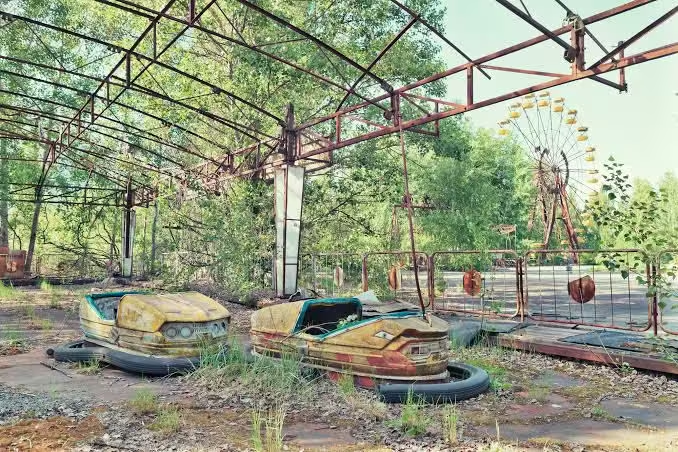
• Pripyat, Ukraine: The abandoned city near the Chernobyl nuclear disaster site, where tourists can explore the eerie remnants of the Soviet-era town.
• KGB Headquarters, Lithuania: A museum in Vilnius that was once a prison and interrogation center during Soviet occupation.
WHY ARE YOUTH ATTRACTED TO DARK TOURISM ?
So why are today’s youth leaving behind serene landscapes for places linked with disaster and tragedy? It’s often the stories—steeped in mystery and history—that draw them in. For example, Kala Pani, once feared for its association with harsh imprisonment, now attracts tourists interested in its haunted past. Similarly, the discovery of human skeletons in Roopkund has sparked a surge in tourism.
THE DOUBLE-EDGED SWORD OF DARK TOURISM
Opinions on dark tourism vary. Supporters argue that it raises awareness about historical events and helps people learn from the past. However, there are concerns about potential negative impacts.
Bhavana Barmi, a psychologist, notes that while dark tourism can be educational, it must be approached with respect.
Glorifying tragedy or spreading false narratives can distort history, and promoting such tourism might amplify negative emotions associated with these sites.
While dark tourism offers a unique way to connect with history, it’s crucial to approach it with sensitivity.
The key is to ensure that these visits are respectful and educational, rather than exploitative.
As this trend grows, travellers must remember that these sites are more than just tourist attractions—they are memorials to the past.